InMotion Studio
How I enabled Indeed's product marketing team to build, deliver, and govern product marketing visuals 88% faster and without the big agency fee
Summary
- Indeed outsourced product UI animations to agencies for hundreds of thousands of dollars a year, with days-to-weeks turnaround. We needed to automate.
- AI image generation doesn't work here — pixel output can't be edited without regenerating the whole image.
- Built InMotion Studio: an AI coding-agent harness + web app that renders visuals as React/CSS/JS code.
- Rolled out over six months and scaled to produce 8-second demos, 90-second sizzles, growth ads, data visualizations.
- Built in governance: creative team gets clean exports, everyone else gets watermarked exports routed through a Slack approval bot.
- Shipped 720 localized visuals in a day; delivered one rush project 6x faster than an agency could.
- Now core to Indeed's marketing pipeline — 88% faster, no agency retainer needed.
The problem
Indeed's marketing team produces product UI animations for landing pages, paid social, sales decks, and trade show materials. These animations show job seekers and employers how our product works. They are core element of our product marketing asset mix.
But producing them is slow and expensive. The in-house creative team is under-resourced for deep motion work, so anything a lot of work had to go to outside motion design agencies — one Indeed's product marketing team pays more than $800,000 a year to retain. With this model, turnaround was measured in days for a simple card animation and weeks for anything with real production value.
The instinct in most organizations is to reach for AI image generation — use diffusion models to produce high-fidelity product screens. That approach does not work for product visuals. Pixel-based output cannot be iterated on without the risk of tweak changing the whole image.
Everything is Code
To solve these problems, I offered a theory: since our product is already built in code, could we harness the power of an AI coding agent to produce more accurate product visuals and set them in motion using web technologies like React, CSS, and JavaScript?
This theory turned into InMotion – an agent harness that runs within Claude Code, Codex, or any other coding agent. It fundamentally changed how we produce product visuals at Indeed by automating the production pipeline of high volume, quality assets at speeds up to 88% faster than agency teams.
The result is a new kind of asset: a small piece of software that can be modified, localized, and versioned like any other codebase. Not just a static image or video file. So, when our product changes or marketing priorities shift, the asset is malleable and easy to change.
Adoption within the team was rapid but methodical. We trained creatives and marketers in parallel in order to test the agent in diverse use cases. Over a span of six months, the agent quickly learned how to produce everything from 8 second feature demos and 90 second product sizzles to growth marketing creatives and data visualizations.
How it works
InMotion Studio is two things that run side-by-side: an agent harness that runs within your preferred coding agent and a web app that shows agent's work in real time. Under the hood is a set of skills, a comprehensive design system, and a ~150-line TypeScript implementation of core animation primitives: frame interpolation, spring physics, frame context, and a composition registry.
This side-by-side setup enables rapid iteration of creative assets through natural language, simple organization of the user's work, translation across locales and industries, and standardized asset exports.
Scaling InMotion
Increased adoption required increased governance. While members of the in-house creative team got full access to InMotion, the rest of the organization received a slightly different version – one that added a watermark to all exports. This elegant solution allowed everyone at Indeed to access the same tool while maintaining brand consistency at scale.
Requests for approval was handled through Slack. The user clicks a button in their web app and a Slack bot routes the watermarked export to a creative team member's instance of InMotion. There the creative can approve the asset or make tweaks before sending it back to the user via the same Slack bot.
Additional features
Documented component library
40+ shared UI components cover the full range of Indeed product surfaces: candidate cards, job listings, search interfaces, employer dashboards, messaging threads, AI chat flows, and more. Each component is documented in the web app's built-in design system reference, with usage notes. This allows the agent to read the docs a designer does.
Localization preprocessing
Each composition stores display text in a strings.ts file. The player's Translate panel exports strings to XLIFF, receives translated files back, and applies them as locale overrides without touching animation code.
Timeline feedback prompts
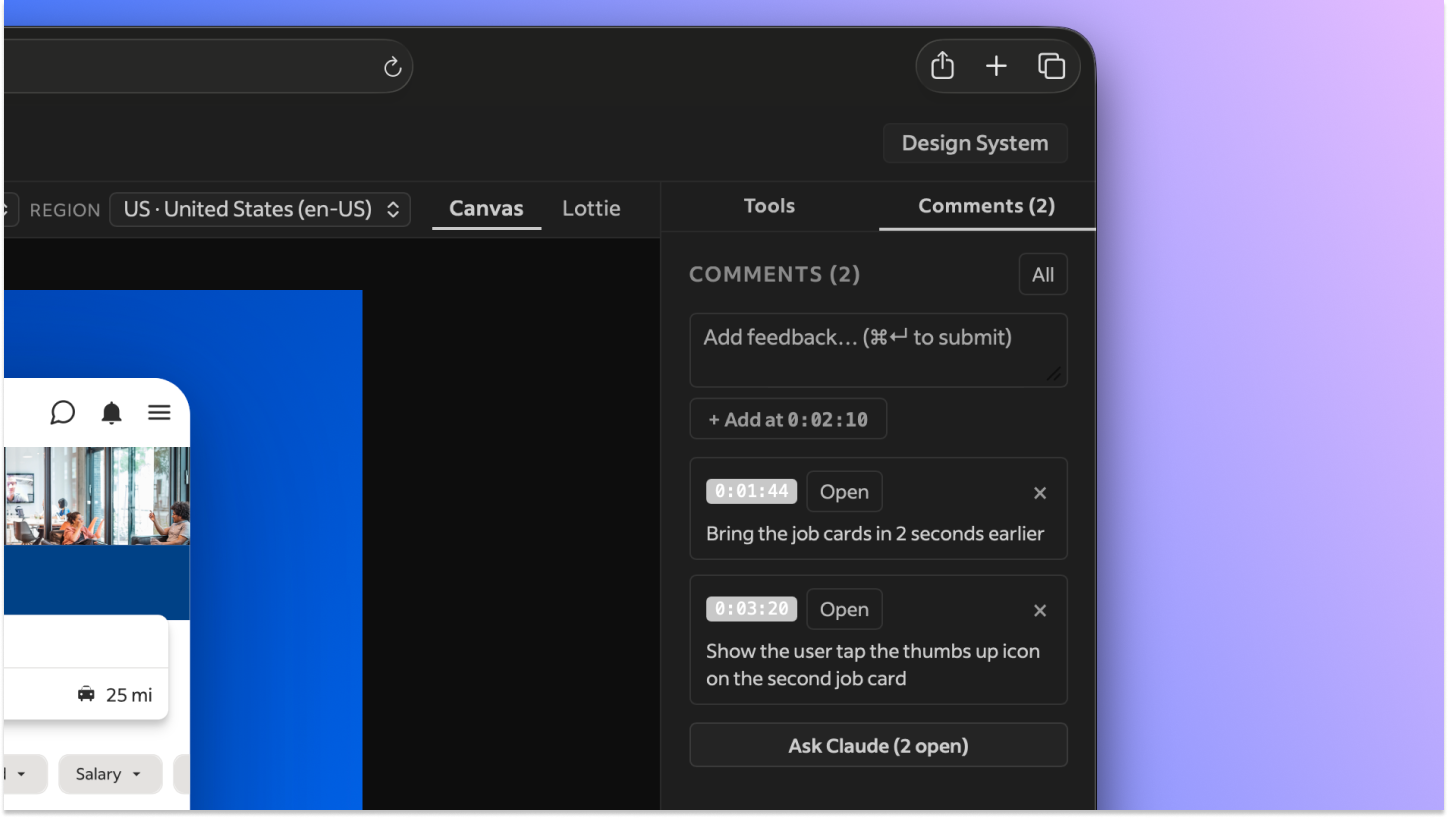
InMotion's player includes a comments panel that pins feedback to specific timecodes – great for targeted, small changes. The Ask Claude button sends open notes back to the agent to resolve, so the user can continue reviewing without waiting for a response.
Outcomes
The first major production run was 720 localized versions of 9 hero product visuals for Indeed's Employer Branding Suite. Nine compositions. Eight regions. Ten industries. After receiving translation guidance from our internal localization team, we were able to ship all 720 versions in a single day.
After a vendor agency turned down a motion graphics project due to short timelines, InMotion was used to deliver the asset in a 6th of the time.
InMotion Studio is now a core part of Indeed's product marketing asset production pipeline. It has been used to produce hundreds of assets across a range of platforms and media while saving money and freeing up time for higher level thinking across the marketing organization at Indeed.