What We Talk About When We Talk About Being Good at the Computer
On spreading patience, agency, and optimism at work and in the community.
Six months ago, I became a volunteer with Austin Free-Net. AFN was founded in 1995 by Sue Beckwith and Ana Sisnett, and it was the first organization to wire Austin's public libraries and put computers in schools and community centers around the city. After a short interview process, one that included a video submission showing how I would walk a client through finding legal help online, they offered me two things: a spot as a teaching assistant for a class of senior citizens, and a shift as a lab monitor at their DeWitty Center location in East Austin.
I've spent eight years since moving to central Texas looking for volunteer work that actually fit me. I love computers, so I said yes to both. I blocked my calendar on Tuesdays from 11:30 to 1:30 so I could make the classroom on time, with enough padding for a quick lunch before heading back to the office. On Saturdays, I gave up lazy mornings so I could be at the lab by 9 a.m. During my three-hour shift, I'd fix up old donated laptops, help walk-ins, and get to know the regulars.
Around the same time I started at AFN, Anthropic released an update to Claude Code, its coding agent. It had launched in February 2025 as a research preview, an early, experimental release meant to gather feedback before an official launch. Claude Code let you build real software through natural language. It could read and write files on your computer, plan a technical approach before executing it, and run processes in the terminal. These are things professional and self-taught developers have done by hand for decades.
I've spent the past twenty-five years teaching myself to write code by hand, and I'm proud of it. I love the hobby enough that if the AI bubble bursts and the tools become too expensive to use, I'd go back to writing code by hand out of love for it. Still, no part of me misses the back pain from a marathon session tracking down an errant curly brace. No part of me misses the eye strain, or the nights it cost my relationships. No part of me misses the gatekeeping I found searching for answers on forums like Stack Overflow.
Enduring those things, and even enjoying them, used to be what made a person good at the computer. But in an age when AI is better at the computer than any human could ever be, what does that phrase even mean anymore?
A Head Start
I've been good at the computer for as long as I've had access to one, and there are a few clear reasons why. The most important is that I got a computer very early. When I was eight, my grandmother bought me an Apple Performa 5400, released in 1996 as part of Apple's consumer-facing Performa line and built around the same "Alchemy" logic board as the higher-end Power Macintosh 5400.
My parents subscribed to AOL soon after and bought a 56k modem so I could take the computer online. As an only child, I had unfettered access. I spent hours building and leveling cities in SimCity 2000, learning about ancient Egypt in Microsoft Encarta, and drilling my multiplication tables in Number Munchers. My parents had the means to buy me the latest technology and the attention to notice I was interested in it. They also enrolled me in schools that centered technology in the curriculum starting in first grade.
But privilege and screen time don't make a computer nerd on their own. People always told me I was good at the computer, that I had a strange knack for troublesome technology. For years, that praise just bounced off me. I assumed everyone my age, with roughly my privilege, could do what I could do. It took six months of teaching senior citizens, and teaching my colleagues at Indeed, for something to click. I finally understood what being good at the computer actually requires. It has almost nothing to do with technical knowledge, or owning the newest gadget, or even liking technology that much. It comes down to three things: patience, agency, and optimism.
Patience
Patience is what lets me spend an hour troubleshooting something that, despite an entire industry of UX designers, still manages to confuse people. Take searching Google with an image, on a laptop with a trackpad that has no physical buttons.
The user first has to find the photo. Say it's local, in the Pictures folder. To search with it, they need images.google.com open in the browser and Finder or Windows Explorer open alongside it. Google's interface nudges everyone toward the same method: drag and drop. So that's what we teach, because no matter what you say in class, the user will see that affordance every time they search on their own. With both windows open, the user clicks and holds the photo file, uses Cmd+Tab to switch from Finder to the browser while still holding the file, then drags it onto the upload area and lets go.
Now imagine doing that as a senior citizen with reduced hand strength and dexterity. Holding down a trackpad without a physical click requires the user to feel the difference between a tap and a press. Dragging means keeping a finger on the pad while moving it precisely, without pressing hard enough to trigger an accidental click. Switching apps with Cmd+Tab means using two specific fingers on one hand while the other hand keeps the file held down. In my experience, this single action can take ten failed attempts before it lands. Along the way, people get frustrated. Some want to quit, afraid they simply can't do it, or worse, that they're wasting my time.
That's where patience becomes less a virtue and more a practice. I have to hold it myself, and I have to show it in my body language. I don't stand over the person. I take a knee and get down to their level. I make eye contact while I give instruction instead of staring at the screen. After every failed attempt, I explain what happened and tell them, gently, that the next try will get it. Most importantly, I never touch their computer. That last rule is a core tenet of AFN's method, and it's what gives each client, which is the term AFN uses for its students, the agency to actually become proficient.
Agency
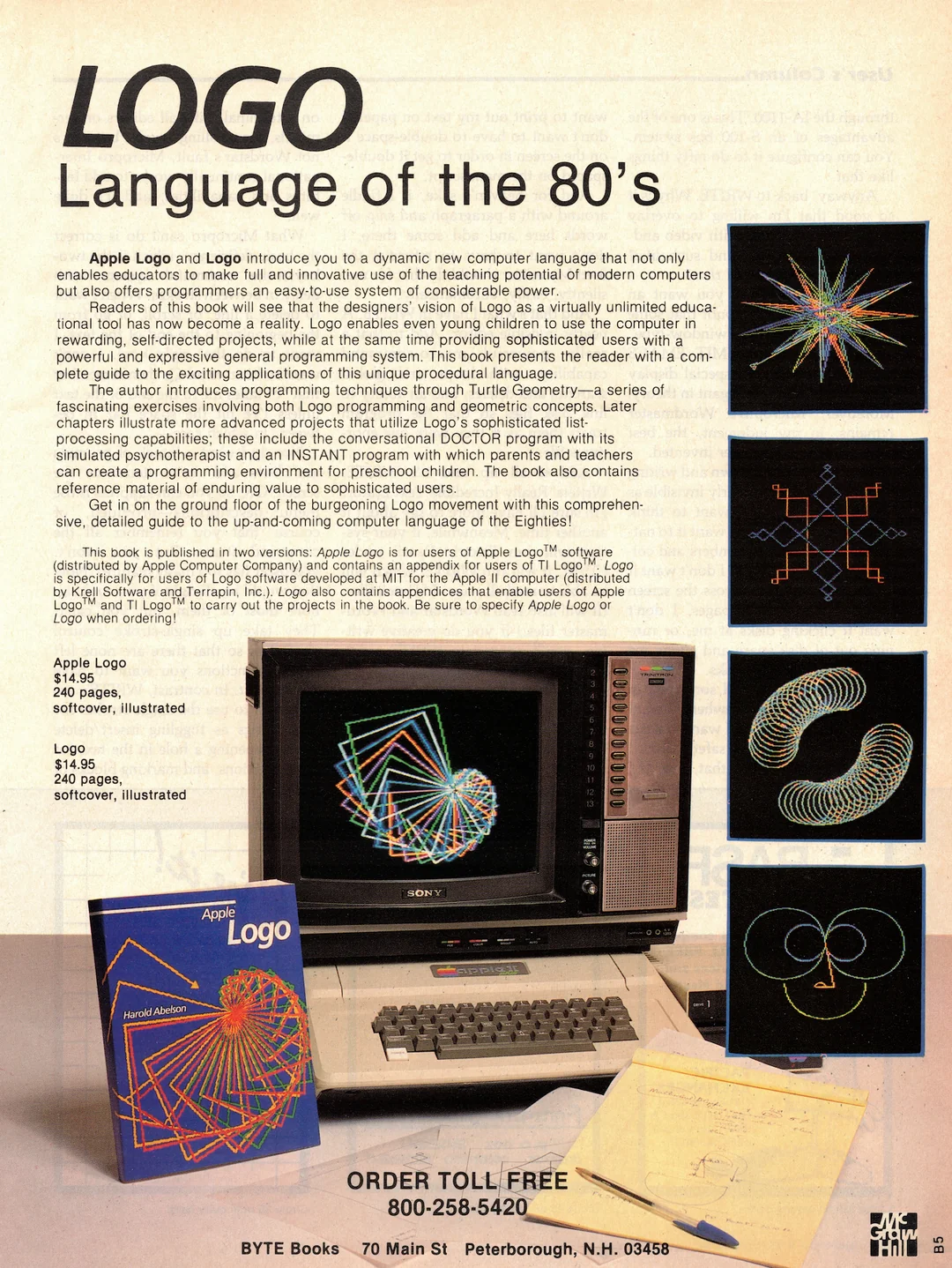
Which brings me to agency. I've been making computers do my bidding since I was eight. In second grade, alongside basic touch-typing lessons, my school gave us access to Logo, a programming language built in the 1960s specifically to teach kids how to think in code by moving a small on-screen turtle around the screen with typed commands. Logo was my first taste of generative art through code, and it taught me something that stuck: I was the one in control. Not the computer. Not Apple Computer Inc.
Having agency with technology means refusing to limit yourself to the expectations of the people who built the software and hardware you own. It means having the confidence to do things your own way, even up against trillion-dollar companies that would rather you use their products in specific, predictable ways. It means building your own tools to make the art and design you actually want to see in the world. That last part is a bit of an obsession of mine. I've built robots that draw with a human's help. I've built a video editor that pairs trending GIFs with music pulled from Soundcloud. I've built a harness for Claude Code that lets anyone at Indeed generate an on-brand product screen animation just by sending a message to a Slack agent.
For the past six months, alongside my work with AFN, I've been trying to give my colleagues at Indeed that same sense of agency over technology, and to help them build tools that solve their own problems.
As of July 2026, I've onboarded more than a hundred colleagues to Claude Code. Across a mix of Zooms with fifty-plus attendees, small group sessions, early morning calls with our team in Dublin, and a handful of 1:1s, I walked people through the basics: the terminal, Homebrew, git, and Claude Code itself.
Indeed hasn't approved Claude Desktop, Anthropic's user-facing front end for Claude, Claude Cowork, and Claude Code. We're required to use Claude Code through the terminal, which meant teaching people to use a piece of software most of them had only seen in 90s hacker movies. The terminal is just a text window where you type commands directly to your computer instead of clicking through menus, and it's the native environment Claude Code runs in. So, with terminals open and Claude Code waiting for a prompt, my colleagues should have been ready to start building. Not even close. This is where most companies fail at AI adoption. Procuring the tools and running the onboarding is the easy part. Inspiring people to actually build something new on top of them is where the real work starts.
This is why agency matters so much. Most computer users underestimate how much power they have to direct a computer toward exactly what they want. I try to build that instinct at every stage.
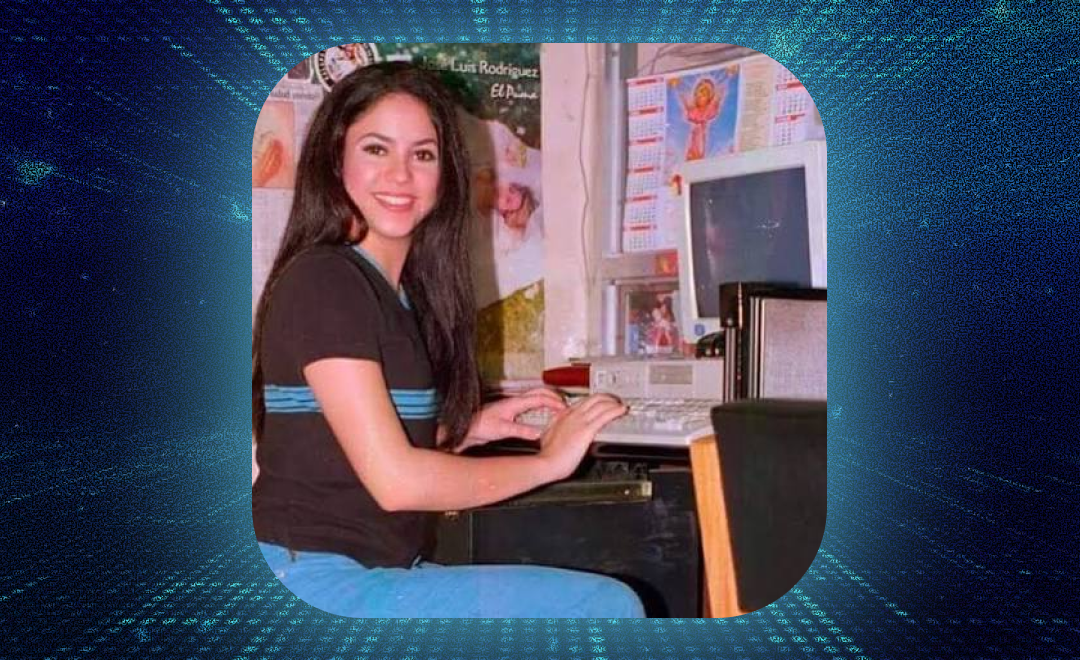
From the first session, I fill my slides with celebrities using boxy, thick early-2000s laptops. Carrie Bradshaw smoking a cigarette while typing on her black PowerBook G3. The Antonio Banderas meme, leaning back after seeing something impossibly cool on his screen. Diane Keaton crying in short bursts while writing a novel on a PowerBook G4. That Shakira photo where she looks genuinely proud to be sitting at a PC. These images are a reminder: technology is supposed to be accessible, and fun, and it's supposed to work for us.
A few weeks after onboarding, I share small exercises meant to open people's minds to what's possible. As a marketing creative team, we constantly build pitch decks in Google Slides to share our work, and Slides lets you embed animated GIFs up to 50 megabytes and 1,000 frames, which is great for showing quick captures of work and stylistic references. For years, we made those GIFs with free online tools full of ads, clunky QuickTime exports, slow After Effects renders, or low-quality results pulled from Google Images. With Claude Code and FFmpeg, that whole process becomes trivial. The exercise I gave people was simple: build a skill for Claude Code that reliably delivers a high-quality GIF under those limits from any source file. In doing it, people learned what a skill is for a coding agent, how powerful FFmpeg is for processing video, and that Claude Code can read and write files on their own machine. The longer-term shift is more important than any of that. It's the first step from being a user of tools to being a builder of them.
A few more weeks in, and several colleagues had built tools that reshaped how the whole team works. One built a photo-editing agent that reviews an entire shoot's worth of files, makes intelligent selects, and narrows down the best candidates before post-production. Another built a web tool to organize performance reports across the thousands of paid social campaigns she oversees. People started sharing codebases with each other and building integrations onto tools that already existed. The product animation agent I built has since been extended by colleagues who noticed a missing feature and, instead of waiting on me to find time for it, built it themselves with Claude Code.
I noticed the pace of adoption picking up, so I encouraged people to share what they'd built. Sharing does two things. First, the range of disciplines represented in those shareouts, technical and non-technical, creative and non-creative, proves that anyone can be a builder in this era. Second, and more importantly, it lets people feel what it's like to have real agency over technology, to watch a colleague's eyes light up because they built something themselves with the most hyped technology in recent memory.
Optimism
Those shareouts build the third and, I'd argue, most important quality: optimism. A recent OECD survey found that about a quarter of adults couldn't use a computer at all, and less than a third counted as moderately or strongly computer literate. Those numbers alone are reason enough for pessimism, and that's before you get to what AI takes on top of it: our jobs, our water, our air, our shared grip on what's real. But when you take technology into your own hands, when you shape the soft clay of code into an app or a workflow or an agent you actually imagined, something opens up. A path where people from every background get to build the technology that shapes their world, instead of just living inside someone else's version of it.
That same optimism shows up in the senior citizens I teach. The same light appears in their eyes the moment they finally land that drag-and-drop, or discover they can pull up a satellite view of the town where they grew up decades ago. When I see that confidence bloom, I pause and name it. "You did it." We sit for a second in that shared energy. Then I push a little further. "Try it again." "Try it a different way." "Look what you just made the computer do."
Celebrating the newly minted builders on my team at Indeed has been one of the great joys of my career. Watching senior citizens become confident with technology, often for the first time in their lives, has been one of the most energizing stretches of my life. It turns out they're the same feeling, just wearing different clothes.
What's Next?
No certification or keynote hands you patience, agency, and optimism. You build them the way you'd build any posture: by practicing it on someone else. That practice looks the same whether I'm teaching a senior citizen to drag a photo across a trackpad or teaching a colleague to prompt an agent for the first time.
This fall, I'm running a follow-up workshop for my team at Indeed, built around what people have already shipped with Claude Code, to push them further into agentic workflows. At AFN, I'm looking for more moments to hand the trackpad back rather than reach for it myself, since that's where the real learning happens. In both rooms, my job stays the same: sit with someone through their tenth failed attempt, remind them the tool bends to their will and not the other way around, and notice out loud, every time, when they finally make the computer do what they wanted. That's the whole trick. It always was.